SKA Conference in France
PRESS RELEASE – Tuesday 26 May 2026
SKAO: the French astrophysics community is rallying behind the world’s largest radio observatory
A three-day conference to prepare French astronomy for the Square Kilometre Array era
From 19 to 21 May, the French astrophysics community gathered for the conference “SKA: an observatory for the entire community”, organised at the initiative of the CSAA (Commission Spécialisée Astronomie-Astrophysique). Nearly 200 colleagues from all generations, including both specialists and non-specialists in radio astronomy research, engineering, and high-performance computing, came together around a shared ambition: to prepare for the scientific exploitation of the Square Kilometre Array Observatory (SKAO), the future largest radio astronomy observatory ever built, developed through an international coalition bringing together countries from five continents. The conference also welcomed leading international guests, including the current Director-General and the future Director-General of the SKAO, the Chair of the SKAO Council, and the Chief Executive Officer of Bull, underscoring the importance attached to France’s contribution to the project.
Designed as a next-generation global infrastructure, the SKAO will profoundly transform the study of the Universe through unprecedented sensitivity and data-processing power. This conference marked an important milestone in structuring the French community around an instrument set to revolutionise many areas of astrophysics.
An exceptional observatory to explore the great mysteries of the Universe
Deployed in South Africa and Australia, the SKAO will combine two telescopes made up of thousands of radio antennas capable of operating as a single giant telescope. Its goal is to observe the Universe with unmatched precision, from the first few hundred million years after the Big Bang to the most extreme astrophysical phenomena.
The discussions highlighted several major advances that the SKAO will make possible:
- mapping cosmic hydrogen to look back to the “cosmic dawn”, the epoch when the first stars and galaxies formed;
- studying the evolution of galaxies and the large-scale structures of the Universe over billions of years;
- detecting and analysing rare and violent transient phenomena, such as fast radio bursts (FRBs), neutron stars, and electromagnetic counterparts to gravitational-wave events;
- deepening our understanding of the interstellar medium, star formation, and planetary environments;
- detecting numerous bursts from stellar coronae, exoplanetary magnetospheres, or star–planet plasma interactions;
- strengthening research on the Sun, eruptive phenomena, and Sun–Earth interactions;
- opening new perspectives for fundamental tests of gravitation and relativistic physics.
One of the key messages of the conference was the deeply cross-cutting nature of the SKAO: far beyond radio astronomy, the observatory will be relevant to the full range of astrophysics, cosmology, and digital science communities.
A scientific and technological revolution
Beyond the scientific opportunities, the conference underlined the exceptional technological challenge represented by the SKAO. The volumes of data produced will reach unprecedented levels in astronomy, requiring high-performance computing infrastructures and artificial intelligence tools capable of automatically processing massive information streams.
Participants discussed, in particular:
- the Science Data Processor (SDP), the true digital core of the SKAO, developed in France;
- the future SKA Regional Centres (SRCs), designed to distribute and exploit scientific data on a global scale;
- French advances in high-performance computing, deep learning, and interferometric processing;
- the energy and environmental sustainability challenges associated with very large-scale scientific infrastructures.
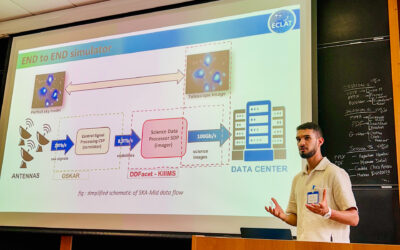
The ECLAT and EXTRACT projects, lessons learned from the LOFAR LoTSS radio survey and from NenuFAR, the French SKA pathfinder, as well as the excellent results achieved by French researchers who took part in the SKA Data Challenges, illustrated the ability of French teams to position themselves on these strategic challenges.
Building the synergies of tomorrow’s astronomy
The final day was devoted to synergies between the SKAO and major current and future international instruments: CTA, ELT, Euclid, JWST, VLBI, LISA, NewAthena, IRAM, ALMA, as well as multimessenger networks dedicated to gravitational waves and neutrinos.
This multi-wavelength and multimessenger approach is one of the most important dimensions of the SKAO. By combining its observations with those of other major infrastructures, researchers will be able to obtain a much more comprehensive view of complex astrophysical phenomena.
The conference also highlighted the importance of involving young doctoral and postdoctoral researchers in this international momentum from the outset, in order to prepare the next generation of SKAO users.
A French community mobilised for the SKA era
Through its deliberately open and interactive format, the conference helped bring together radio astronomy experts and researchers from other disciplines. This openness now appears to be an essential condition for fully exploiting the scientific potential of the SKAO.
As the observatory moves towards progressive commissioning, the French community intends to play an active role in this global scientific endeavour, at the crossroads of astrophysics, digital science, and disruptive technologies.
Scientific Contacts:
- Benoit Famaey (Président du Comité Scientifique de la conférence) : benoit.famaey@astro.unistra.fr
- Chiara Ferrari : chiara.ferrari@oca.eu
Press Contact:
- Margaux Arav : margaux.arav@oca.eu