From Morocco to Oxford, Marwane Dalal is building bridges around the SKA
As a PhD student at the ECLAT laboratory, Marwane Dalal is developing a digital twin of the SKA at the interface between radio astronomy and high-performance computing. From his presentation to the Moroccan Academy of Sciences to the YERAC conference in Oxford, his career path illustrates ECLAT’s ability to foster new scientific collaborations and to develop the digital tools required for the future observatory.
A path shaped by scientific excellence and international openness
Within the ECLAT laboratory, Marwane’s work on the SKA digital twin brings together radio astronomy and high-performance computing. A PhD student and laureate of the Moroccan General Competition, he recently presented his project to the Academy of Sciences in Morocco. This initiative is part of a broader ambition to bring scientific communities closer together and foster new collaborations. “Being a PhD student in this multinational project encourages me to connect with Moroccan scientists and research centres, so that potential collaborations can emerge and the framework of contributions to the SKAO can also extend to North Africa,” he explains. Morocco also has strong expertise in high-performance computing, notably with Toubkal, one of the largest supercomputers in Africa.
« I was, in a way, ECLAT’s ambassador for the HPC dimension of my PhD »
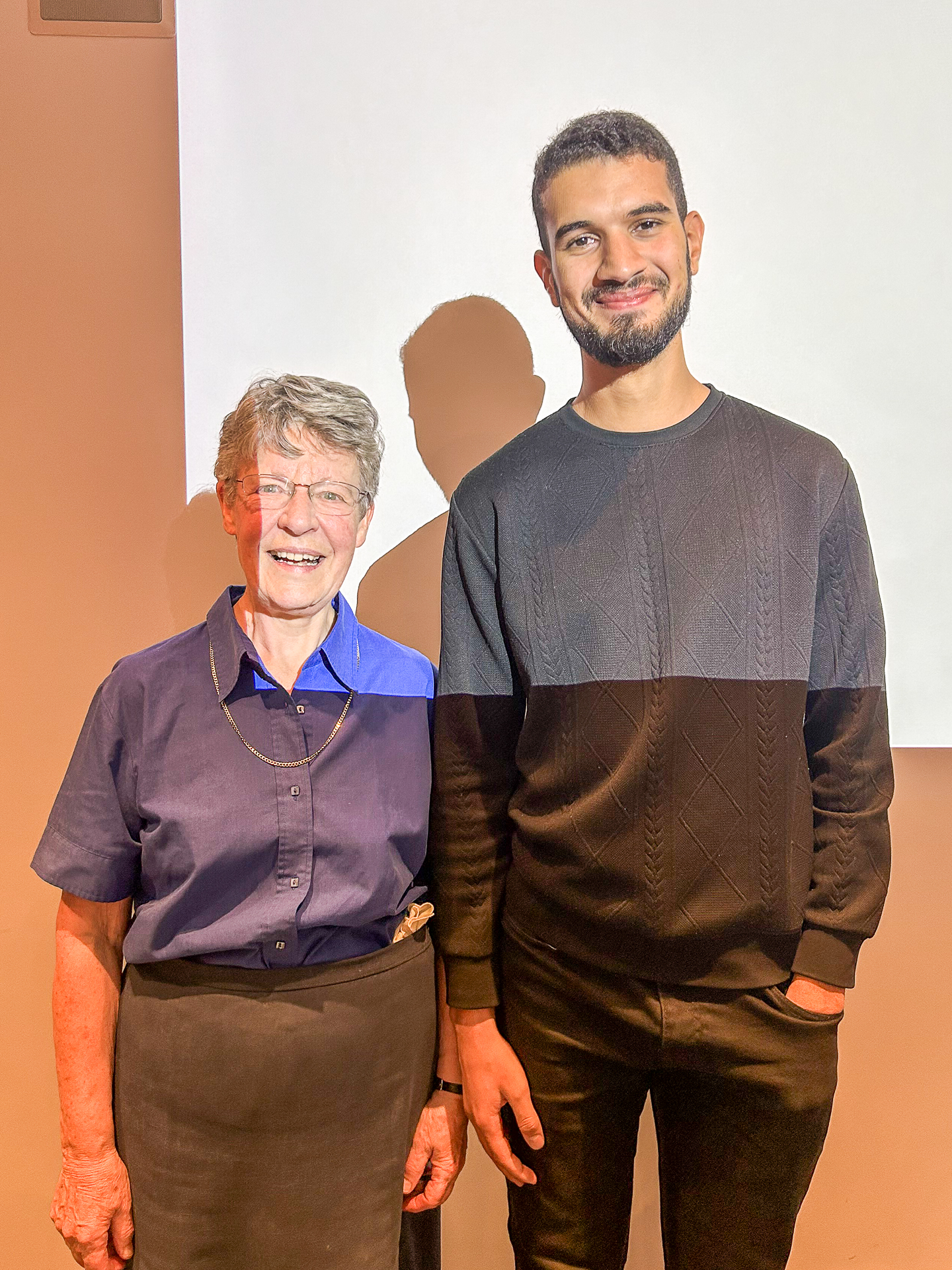
Jocelyne Bell, who discovered pulsars in 1967, and Marwane Dalal at Yerac 2026, Oxford.
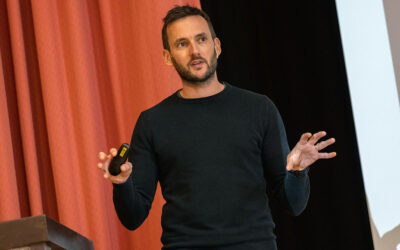
This international dimension was also reflected at the YERAC conference, the Young European Radio Astronomers Conference, held in Oxford this summer and bringing together young radio astronomers from across Europe. “I was, in a way, ECLAT’s ambassador for the HPC dimension of my PhD,” he explains. His presentation showed how codes are deployed on supercomputers to simulate the massive data volumes of the SKAO.
The development of the SKAO relies on computing capabilities able to match its scientific ambitions. While the future observatory is expected to enable major advances in radio astronomy, it also introduces unprecedented data constraints. The volumes produced will be so large that it will not be possible to store everything and process the data later. A large part of the processing will have to be carried out in real time. “With the SKA, we will not have time to store all the data and process it later at our own pace,” Marwane explains. “Everything has to happen in real time: data generation, numerical processing, and then the production of the final scientific images.”
Simulating the operation of the future observatory
His PhD work focuses on developing a digital twin of the SKA, a software chain that simulates the production and processing of telescope data. The signals generated by the antennas are correlated to produce “visibilities”, which are then transformed into scientific images. To ensure high performance and good portability, Marwane has tested his codes on several architectures, including Jean Zay and Dalia, which is equipped with latest-generation NVIDIA GPUs.
The scientific use cases used to test this chain are particularly demanding. Marwane works in particular on protostellar clusters, regions where several stars are forming and whose complex structures make observation difficult. “We use this case because it is highly challenging for the pipeline,” he says. “It allows us to test the simulator’s ability to detect an object and assess its precision.”
« The ultimate goal of this hacakthon is to connect everything together, to build a complete GPU-based simulator that works from beginning to end. »
A hackathon to connect the different building blocks
This work will be at the heart of the next ECLAT hackathon, planned for October. The objective will be to connect the different building blocks developed by the laboratory’s partners in order to move towards a more complete simulation and processing chain, ported end-to-end on GPUs. Marwane will contribute the building block he has been working on since the beginning of his PhD, while other teams will contribute to the imaging, deconvolution and optimisation stages. “The ultimate goal is to connect everything together, to build a complete GPU-based simulator that works from beginning to end,” he summarises.
This hackathon will therefore be an important step for ECLAT. It will help consolidate technical developments, test their integration on advanced computing architectures, and strengthen the collective momentum between partners.