“With ECLAT, we work in direct contact with scientific application developers”
How can high-performance computing keep pace with the data challenges of next-generation radio astronomy? In this interview, François Tessier, Inria researcher and I/O specialist, explains how ECLAT provides a rare opportunity to work directly with scientific application developers, test research on real SKA-related pipelines, and prepare future computing infrastructures, from NumPEx to the Exascale era.
Interview with François Tessier, Inria researcher and specialist in I/O for high-performance computing.
Could you briefly introduce your background and research field?
I defended my PhD in 2015 at the University of Bordeaux, within an Inria-affiliated team. I then spent nearly three years as a postdoctoral researcher at Argonne National Laboratory, near Chicago in the United States, before joining the Swiss National Supercomputing Centre, CSCS. I was then recruited by Inria almost six years ago. Today, I work within the KerData team, which focuses on data management in distributed systems and high-performance computing.
Historically, the team was strongly oriented towards input/output, or I/O, large-scale storage, and parallel file systems. These topics remain at the core of my work, even though the team has expanded into other areas such as workflows, federated learning, and certain aspects of quantum computing. The common thread across all these topics is data: how it moves, how it is stored, and how it can be used efficiently.
What does ECLAT concretely bring to your research?
For us, ECLAT is a particularly valuable use case. In the field of HPC, we often develop models, algorithms, or optimization methods, but it is difficult to test them on real scientific applications. We sometimes have access to benchmarks, simplified versions, or execution traces, but rarely to the applications themselves and to the people who develop them.
With ECLAT, it is different: we can interact directly with the scientists and engineers who write the code used to process data from radio telescopes, understand the choices they make, and run the applications. This proximity is rare and extremely valuable for experimental research.
« With ECLAT,we can interact directly with the scientists and engineers who write the code. »
« The objective is to better understand application behaviors, classify them, and then produce recommendations. »
In concrete terms, what are you trying to optimise?
First of all, we do not modify the hardware: we work with it. Our work takes place between the application and the storage systems. A major part of our research consists in analyzing how applications read and write their data. We collect execution traces produced by computing centers and then try to identify recurring patterns.
The objective is to better understand application behaviors, classify them, and then produce recommendations or predictions. One goal is to transmit this information to a supercomputer scheduler so that it can allocate computing and storage resources more intelligently.
Does ECLAT make it possible to go beyond this general analysis?
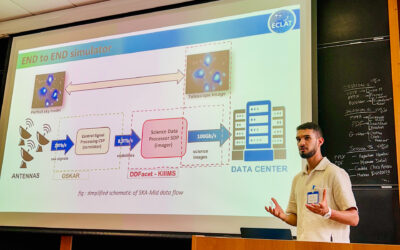
Yes, that is precisely its value. Within ECLAT, we are not working only on abstract traces. We have a concrete scientific pipeline related to the processing of radio astronomy data, with components such as DDFacet and KillMS. An intern funded by ECLAT, Pietro Mani, is currently working with me on monitoring the I/O of the complete pipeline. He is now able to produce graphs showing the evolution of resource usage and data access during execution. This is an important step: it allows us to move from theoretical understanding to precise measurement on a real application.
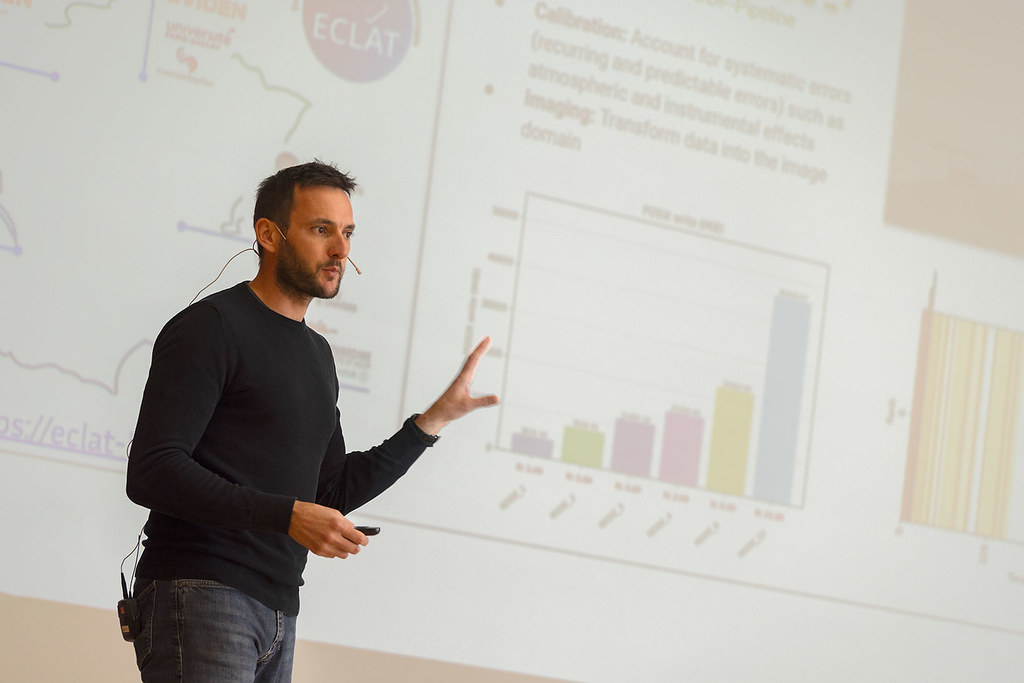
François Tessier, NHR conference, 2025, Copyrights photo: NHR-Verein e.V
How does this work connect with the NumPEx project?
There is strong continuity between ECLAT and NumPEx. NumPEx aims to prepare the French software stack for the Exascale era, that is, for machines capable of reaching enormous levels of computing power. In this context, certain use cases play a structuring role, including the SKA. In practice, when we talk about the SKA within NumPEx, we are also, and above all, talking about the work carried out in ECLAT around radio astronomy processing pipelines. This allows us to connect an international research infrastructure, the SKA, a national joint laboratory, ECLAT, and the broader challenges of preparing the French HPC ecosystem for Exascale.
Is artificial intelligence also changing your field?
Yes, at two levels. First, it is changing our methods: we are beginning to use AI techniques to analyze large volumes of execution traces and automatically extract access patterns.
Second, it is changing the applications themselves. AI-related workloads often read very large volumes of data, sometimes with access patterns that were rarely seen before, whereas traditional numerical simulations were more dominated by write operations, particularly for checkpoints. This evolution is transforming supercomputer usage profiles and making I/O analysis even more strategic.
« AI is transforming supercomputer usage profiles and making I/O analysis even more strategic. »
What does ECLAT represent for you beyond the technical dimension?
ECLAT is a remarkable space for dialogue between two worlds: astronomy and high-performance computing. For us, as computer scientists, working on the SKA is highly motivating. It is a major scientific use case, visible and ambitious, which gives meaning to research that can sometimes be perceived as very technical. I/O and storage do not always inspire students; but when we explain that this work contributes to preparing the operation of the world’s largest radio telescope, it immediately changes how the topic is perceived. ECLAT therefore also plays a role in attracting talent, structuring work, and fostering scientific cohesion. It is a laboratory that makes research more applied, more closely connected to scientists’ needs, and potentially more useful for future computing infrastructures.