News and Events

Webinar: Center for Excellence in Performance Programming from Eviden
Eviden Center for Excellence in Performance Programming (CEPP)The rise of exascale, LLM and machine learning poses challenges in terms of managing large datasets, hardware evolution and power consumption. Optimizing code for diverse systems and recruiting AI data...
Interview with Chiara and Damien on the 2025 review
2025 marks a turning point for the ECLAT laboratory, which closes its second exercice on a high note and enters its third cycle. Damien Gratadour, Director of ECLAT, and Chiara Ferrari, Director of SKA France, sum up the company’s positive results: strengthened...
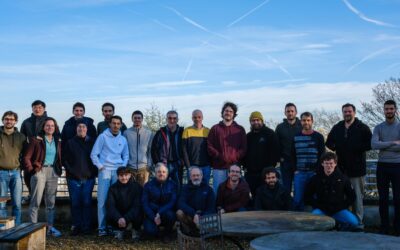
ECLAT accelerates the development of a workflow for radio-interferometric imaging in the exascale era
As radio astronomy enters the exascale era, the ECLAT laboratory is working on the workflows of tomorrow. Gathered in Meudon for a hackathon and technical workshop, researchers and industrial partners accelerated the development of a prototype "end-to-end" processing...
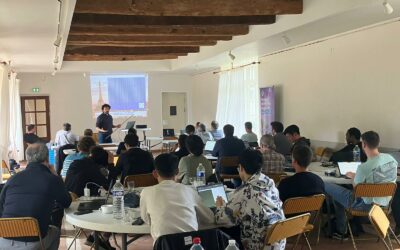
Technical workshop 2025 and hackathon
The 2025 edition of the ECLAT Technical Workshop and Hackathon brings together researchers, engineers, and partners to address the challenges of next-generation radio astronomy pipelines. Over five days, participants will discuss recent advances—from rapid prototyping...
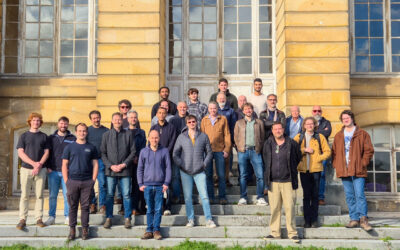
Behind the scenes of the first ECLAT GPU hackathon
Held from October 20 to 24, 2025 at the Observatoire de Paris-PSL, the first ECLAT GPU hackathon marked an important step towards meeting the challenge of the coming data deluge, by officially launching a new international initiative to accelerate data flows using GPU...

Webinar – Beyond Speed: Integrating Energy Considerations into I/O Performance Analysis for SKA Codes
Beyond Speed: Integrating Energy Considerations into I/O Performance Analysis for SKA CodesAstronomical data processing codes for the analysis of massive observations are inherently demanding in terms of computational resources and input/output (I/O) operations. The...