International hackathon in Rennes on DDFacet and RIMS
For a week in March, IRISA in Rennes hosted a hackathon bringing together around ten researchers, engineers and PhD students from France, South Africa and the United Kingdom. The event focused on two main areas: improving the DDF Pipeline radio astronomy imaging software, particularly in terms of portability and scalability, and developing the RIMS project, dedicated to the production and sharing of dynamic spectra for the study of rare events. This collaborative work is essential for preparing to utilise data from current and future radio telescopes.
International hackathon in Rennes on DDFacet and RIMS: two approaches to tackling the challenges of radioastronomical data
Could you introduce yourself and explain what you are working on?
Athanaseus Ramaila: I’m from South Africa, based in Cape Town at the South African Radio Astronomy Observatory. I am also a PhD student at Rhodes University, Centre for Radio Astronomy Techniques and Technologies.
I work as a scientific software developer. My day-to-day work involves developing data reduction pipelines for radio interferometers, as well as software packaging and general software development for radio astronomy tools.
The instruments are getting larger and more complex, and we want to build pipelines that can be used for any radio interferometers around the world. The group I am part of, the Radio Astronomy Research Group, actively researches and benchmarks algorithms to address the challenges posed by increased data volume and complexity. We also explore the various tools available within the community and build our pipeline in such a way that users can choose between, or even compare, different tools, and one of these is DDFacet. Currently, DDFacet is considered the best tool for processing this type of data.
« Currently, DDFacet is considered the best tool for processing this type of data.»
« Today, the challenge is to make these pipelines work on a large scale.»
Martin Hardcastle: I am a professor of astrophysics at the University of Hertfordshire in the UK. I work on extragalactic active galactic nuclei, which are black holes accreting matter and producing radio signals. My interest lies in extracting scientific insights from the data, which involves working with pipelines that produce the best possible images.
The process of obtaining the best images from radio telescope data is highly complex. We began over ten years ago developing code to produce the best possible images. Now, the challenge is to run these pipelines at a large scale, to generate maps of the entire sky. We are working with thousands of datasets, and we need to process them efficiently and repeatedly.
Mathis Certenais: I am a PhD student at IRISA and I work on collaborative systems for scientific data logistics. I had the pleasure of organising this hackathon.
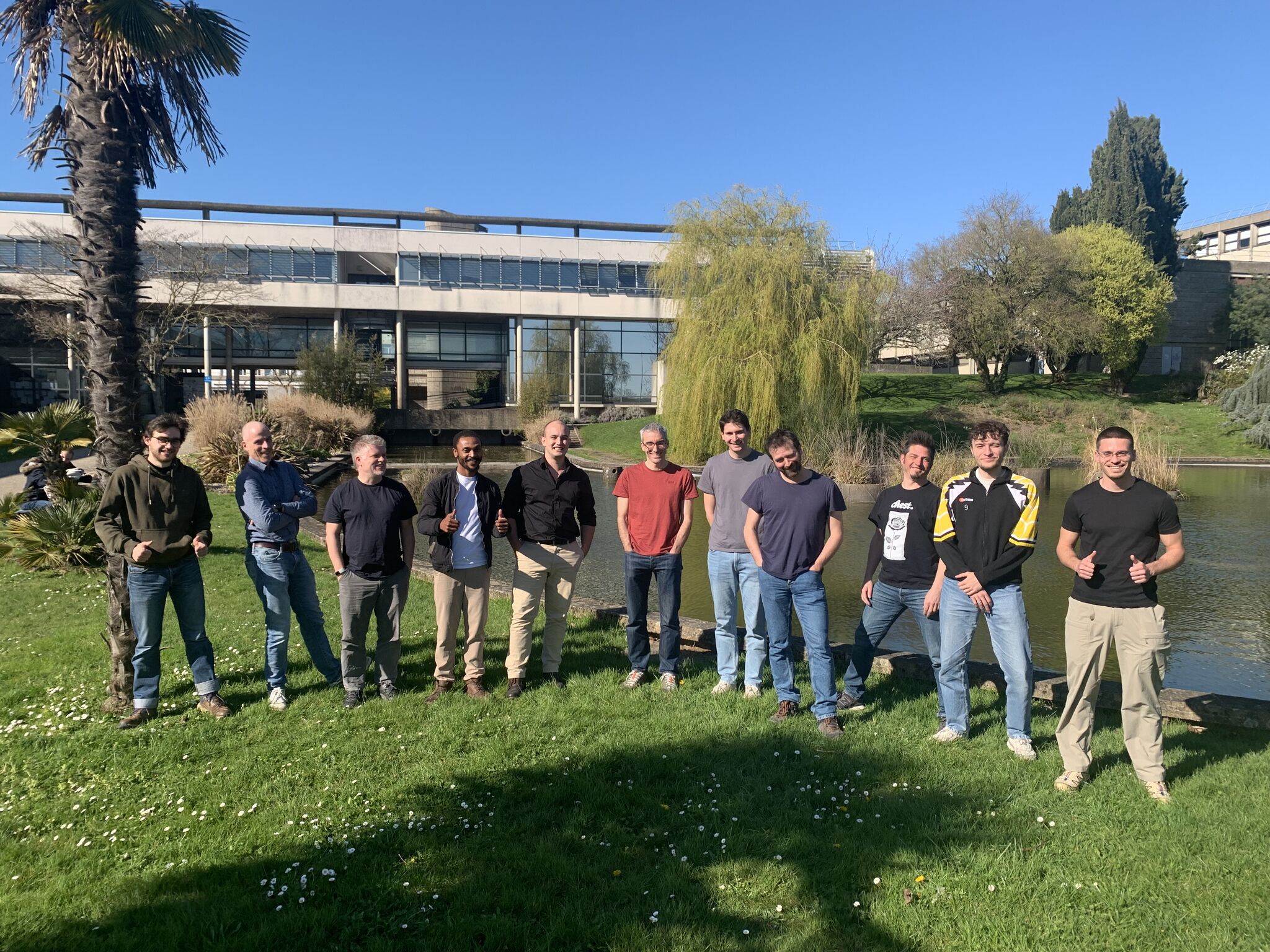
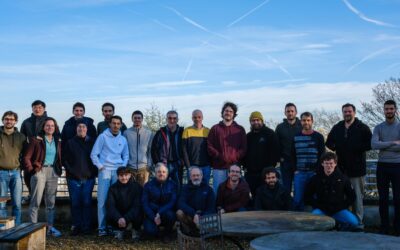
The international DDFacet and RIMS hacakthon team in Rennes, March 2026
What are the objectives of the hackathon?
Mathis Certenais: The aim is to bring together participants from different countries to work on two main topics: the DDF Pipeline on the one hand, and the RIMS project on the other.
Regarding the DDF Pipeline, the idea is to work on the software’s portability and on distributed processing to speed up its execution. Initially, the software operated sequentially, which was suitable for laboratory servers. Now, we want to take advantage of high-performance computing resources, with several interconnected nodes, to perform distributed processing, handle the large volume of data generated by the telescopes. Currently, the distributed version of the software runs on four different systems. We have already achieved an initial result: we have reduced processing time from 68 hours to just over 8 hours in the Jean Zay supercomputer. We are therefore approaching a 1:1 ratio between observation time and processing time.
We are also working on portability: being able to install and run the software on different machines, with different hardware and software environments, whilst maintaining good performance. The aim is for each participant to be able to leave with functional software on their machine, and for new users to eventually be able to install and use it easily. The first step was to carry out tests on the Jean Zay supercomputer, then we managed to run the software on the French CINES HPC center with the Adastra supercomputer, and finally on a machine located in England, and even at one of our industrial partners, Bull.
« We have already achieved an initial result: we have reduced processing time from 68 hours to just over 8 hours in the Jean Zay supercomputer.»
« The point of testing the MeerKAT extension is actually to prepare for next-generation instruments, such as the upcoming SKA.»
Athanaseus Ramaila: For this hackathon, the main objective was to test whether, by simulating the instrument we will have once the MeerKAT extension is complete, DDFacet would be able to handle it. So we have a set of simulated data that we’re currently testing, and so far everything has gone well, and I’m running some diagnostics to see how accurate the results are.
Part of our research involves creating tools that can be used by the astronomy community, primarily in radio astronomy. Our main objective is to build a pipeline that can be used by different instruments and that will integrate various tools, including DDFacet. The point of testing the MeerKAT extension is actually to prepare for next-generation instruments, such as the upcoming SKA, which will be an even more complex instrument.
And what about the RIMS project?
Mathis Certenais: The RIMS project aims to build a collaborative data-sharing network to improve the detection of rare events. One of the key elements is the terms and conditions, defined at the beginning. In fact, we must earn the trust of data producers, from any radio telescope, by encouraging them to publish dynamic spectra for the entire community. This requires clear rules, including embargo periods that temporarily restrict access to data for publication purposes.
During this hackathon, we launched the initiative by integrating UK-based data storage with metadata hosted at IRISA, connected through a unified framework that publishes both datasets and metadata across systems. A first web interface now allows authenticated users to browse a dedicated catalog, locate data, and access it efficiently. Our focus is on simplifying data sharing while standardizing how information is pooled. Future work includes adding embargo filters to restrict access, letting authors define embargo durations and authorized users. We’ll also introduce integrated visualization tools directly in the interface, enabling astrophysicists to analyze data seamlessly. The goal remains: better data, better collaboration.
« The RIMS project aims to build a collaborative data-sharing network to improve the detection of rare events.»
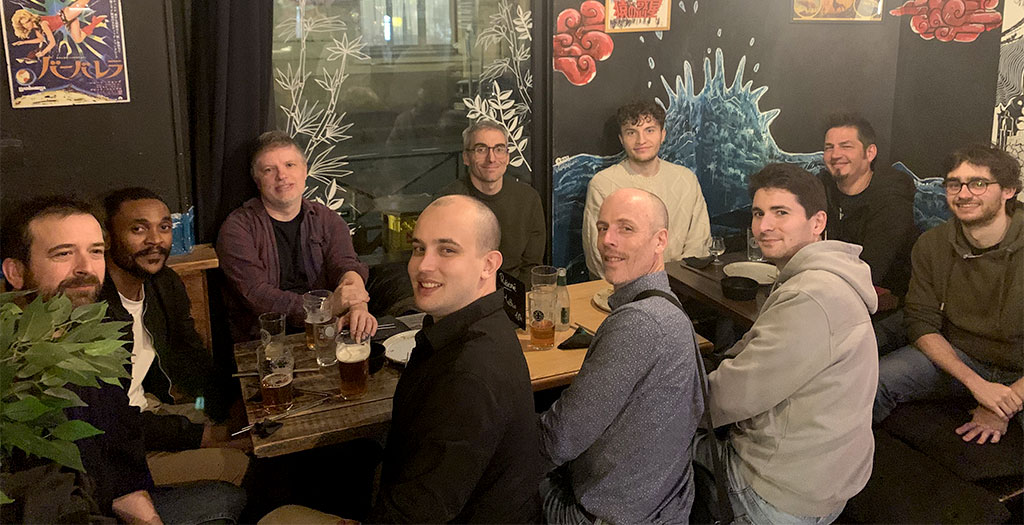
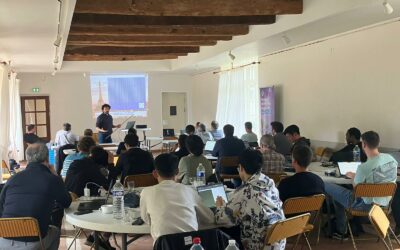
The hacakthon team in Rennes, March 2026
I’m trying to ensure that RIMS actually works, that it runs quickly and that we can store the data centrally, and run it in a distributed manner across several different sites.
So the next step is to expand it to more sites and, if possible, to more telescopes. And, well, if we manage to get this working, we’ll then have this incredible archive of data that a user can simply go to and say: ‘I want to know everything about all these stars.’
What is the benefit of this international collaboration?
Athanaseus Ramaila: We learn from each other. I’m here to understand what tools others are using and to contribute our own techniques.
Martin Hardcastle: Everyone brings something different. These hackathons are very collaborative. You can simply ask for help, and someone will help you straight away. A few days like this are far more useful than countless emails.
Mathis Certenais: This type of event allows us to engage with others, share different approaches and make much faster progress. Without these collaborations, we would quickly reach our limits.