ECLAT 2025 : Review
2025 marks a turning point for the ECLAT laboratory, which closes its second exercice on a high note and enters its third cycle. Damien Gratadour, Director of ECLAT, and Chiara Ferrari, Director of SKA France, sum up the company’s positive results: strengthened collaborations, concrete projects and unprecedented scientific ambition.
Interview with Chiara Ferrari, Director of SKA France, Damien Gratadour, Director of ECLAT and Jacques Tissot, Communications Manager at Neovia Innovation.
To begin with, Damien, how would you describe the year 2025 for the ECLAT laboratory?
Damien: 2025 is the end of the second year, which ended with our superb event at the Manoir de Kerazan in Brittany, and the start of the third year, which will continue into the first half of 2026. The third year is really the year of maturity, I think. Projects come to life. The teams know each other, have started working together and are keen to develop new ideas or set up new projects.
At Kerazan, we tried out a new format that generated a lot of enthusiasm, with a hackathon and a general meeting. We did the same in Meudon at the end of the year. We discovered that hackathons enabled us to considerably develop collaborations, including on an international level with our Italian colleagues at INAF, our South African colleagues at SARAO and even our American colleagues at SETI and Nvidia. We now want to organize more local events around our regional clusters in Brittany, Bordeaux, Nice and Paris.
So new hackathons for 2026?
Damien: Yes, during our two annual events in June and December and, I hope, synchronized local hacakthons between clusters, Rennes and Bordeaux in parallel, for example. It’s also essential that we continue to set up projects to finance our work. We need to consolidate certain aspects of our roadmap, such as support for the French node SKA Regional Centers (SRC). These are the computing infrastructures that the scientific community will use to exploit the SKAO data once it is up and running. We also want to emphasize the use of deep learning for data processing. Another emerging theme is transient astronomy.
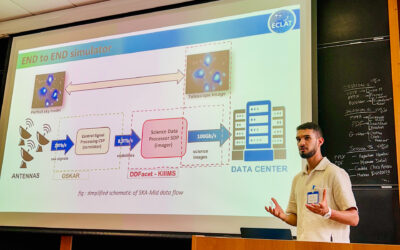
Left: Public conference at the Manoir de Kerazan, June 2025
Would you say that the targets set for 2025 have been achieved?
Damien: The general aim of our Laboratory 2.0 is to fuel research into the major digital challenges facing astronomical observatories. With this in mind, ECLAT’s results are proof of its dynamism: active collaborations, project funding worth millions of euros and seven theses launched in 12 months. For example, the thesis of Marwan Dalal (University of Bordeaux) was born out of ECLAT’s reflections and is part of the ODISSEE project (although not directly financed by the project). We’re creating an ecosystem where projects feed off each other naturally. We could also mention the thesis by Rémi Cazoulat (CNRS) on the acceleration of imaging workflows via dataflow modeling. My responsibility is to be the guarantor of the roadmap and to maintain the momentum that unites these 15 teams and 50 people.
” We need to consolidate certain areas of our roadmap, such as support for the French SRC node. “
Chiara, what are the key points for SKA France in 2025?
Chiara: One highlight was the signing of the contract between SKAO and Eviden for the supply of two supercomputers. Another highlight was the announcement of the imminent arrival of the French exascale supercomputer Alice Recocque. And, as Damien said, we have made progress in defining the French solution for the SRC.
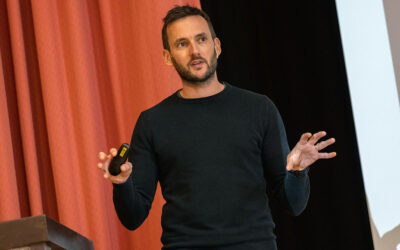
Right: GPU hacakthon, October 2025
“ECLAT is also the place where we do digital R&D for SKAO.”
How does ECLAT facilitate these progresses?
Chiara: The reason SKA France wanted to create this lab com was to have a structured discussion space between the various partners and beyond. This objective has been achieved because, through hackathons and technical meetings, ECLAT is able to bring together players from different worlds: astronomers, industrialists and experts from the digital world.
For me, ECLAT is also the place where we do digital R&D for SKAO. The laboratory works on both aspects of data processing: the SDP (data processing near the antennas) and the SRCs (which will absorb data from the SDP). In 2025, ECLAT will have laid the first bricks on the SDP. So there’s this work of animation and algorithmic development that’s been carried out over the course of 2025, and I can’t wait to see what will be done for 2026.
Any last words?
Damien: ECLAT is first and foremost a human adventure, with researchers, engineers and doctoral students collaborating on the technical side. But we also have the support of lots of other people who help us organize our events, manage logistical problems and budget issues, and without them, there’d be no ECLAT either, so thank you to all these people who support us and bring ECLAT to life, just as much as the members of the labs!
Chiara: Yes, well done to ECLAT and thank you to our partners: CNRS, Inria, Paris Observatory, Côte d’Azur Observatory and EVIDEN. It’s really beautiful and important to see such a collaboration progressing so well!